Thinking about pressure washing your house, but worried about damaging your surfaces? Not sure whether to clean your house in a DIY manner or get someone to do it?
You’re not alone. Although cleaning with high-pressure water is undoubtedly the most efficient way to make your house look renewed and fresh, a slip-up with a pressure washer may easily result in costly damage to the surfaces.
The guide will include the entire range of information you need, including the most valuable safety measures and the science behind PSI, as well as what surfaces should be washed softly and when it is prudent to call the specialists to do the proper work of home power washing.
Key Takeaways
- Use the right PSI for each surface to clean effectively without causing damage.
- Start at the top and work down for a cleaner, more even result.
- Check and prepare surfaces first by looking for cracks, covering sensitive areas, and protecting plants.
- Avoid high pressure on delicate surfaces such as windows, roofs, wood, and painted areas.
- Use the right cleaning products and rinse surfaces properly to prevent residue and damage.
- Never pressure clean from a ladder or attempt risky multi-storey work without the proper equipment and training.
- Pressure cleaning once a year is a good general maintenance guideline, with more frequent cleaning needed in humid, shaded, coastal, or polluted areas.
- Professional cleaning reduces the risk of damage because experts understand surface types, PSI settings, cleaning products, and safety requirements.
Understanding the Value: Why Pressure Cleaning Matters
Frequently identified pressure washing of your house repair is an important aspect of preventative property treatment, offering much beyond a mere cosmetic makeover. It is equally relevant in maintaining standards for commercial office cleaning, where cleanliness directly impacts professional image, safety, and long-term asset care.
- Long-Term Surface Preservation: The environmental pollutants, such as dirt, grime and acid rain, may be corrosive. More to the point, not only does organic growth, such as mould, mildew, and algae, appear unsightly, but it can, in fact, consume and wear away paint, sealants, wood, and concrete over time, resulting in premature destruction. Weed killing is done on the outside of houses to kill these destroying agents, thus increasing the life of your materials.
- Health and Safety Improvement: Mould spores and pollen on exterior surfaces are common allergens that can enter indoor spaces through ventilation systems. Pressure cleaning eliminates these contaminants, supporting healthier conditions often associated with professional mould cleaning services, while also removing slippery buildup on walkways and decks to reduce accident risks.
- Maximising Property Value: An exterior that is clean will always increase the curb appeal. One of the fastest and inexpensive methods of enhancing the perceived value of your house is through pressure washing, which is also essential when selling or refinancing.
The Do’s: Best Practices for Effective Pressure Cleaning
Achieving safe, streak-free results requires adherence to proven techniques.
Do Use the Right Equipment and PSI Settings
The force of your wash is measured in PSI (Pounds per Square Inch). Selecting the correct PSI for the surface material is the most important factor in preventing damage during home power washing.
| Surface Type | Recommended PSI Range | Nozzle Tip (Colour) | Rationale |
| Vinyl/Aluminium Siding | 1200–1500 PSI (Soft Wash) | White (40° angle) | Enough force to clean, low enough to avoid warping, cracking, or driving water behind the siding. |
| Wood/Decking | 500–1200 PSI | Green (25° angle) | Wood is soft and porous. Higher pressure will splinter or etch the surface, requiring a gentle touch. |
| Concrete/Driveways | 2500–3000 PSI | Yellow (15° angle) or Turbo | Concrete is robust and requires high force to remove deeply set oil stains, tyre marks, and heavy grime. |
| Painted/Delicate Brick | < 1500 PSI | White (40° angle) | Use caution; high pressure can damage mortar joints or strip old paint/sealants. |
Expert Tip: Always select the widest angle nozzle suitable for the job and move closer slowly.
Do Start from the Top and Work Downwards
This simple directional rule is vital for quality exterior house cleaning. Starting with detergent (where necessary) at the bottom and upwards, so that the chemical may rest there until rinsed away from the top. Rinsing down will make sure that dirty water and chemical leftovers will fall on previously washed/cleaned or to-be-washed areas, and will not leave ugly stains nor contaminate the recently washed ones again.
Do Inspect and Prepare Surfaces First
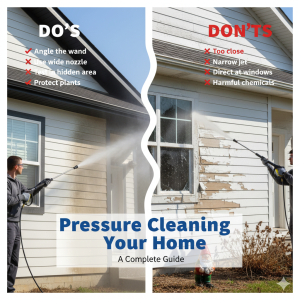
Thorough preparation ensures safety and prevents unexpected damage. Before you pressure wash your house:
- Check for Defects: Look for loose siding, cracked stucco, chipped paint, or weakened mortar joints. High pressure will exploit these weaknesses.
- Seal and Cover: Ensure all windows and doors are completely shut. Use plastic wrap and tape to seal sensitive areas like electrical outlets, light fixtures, and exterior vent openings to prevent water intrusion or shock hazards.
- Protect Plant Life: Soak nearby grass, shrubs, and flowers with plain water. This allows them to absorb water, making them less likely to absorb concentrated cleaning detergents. Cover delicate plants entirely.
The Don’ts: Costly Mistakes to Avoid
Inexperienced use of high-pressure water cleaning equipment is the leading cause of residential damage.
Don’t Use Too Much Pressure on the Wrong Surface
This is the quickest method of harm. A powerful pressure stream of wood can permanently cut clear lines (zebra stripes) into the surface. Excessive application of PSI to the vinyl siding can bend it out of shape, whereas on the concrete, it can also polish the surface (etching), making it more porous and prone to subsequent growth of dirt and mould.
Don’t Pressure Wash Sensitive Areas
- Windows: High pressure can bypass the seals of double-pane windows (leading to fogging) or even shatter single panes.
- Electrical Areas: Direct contact with electrical components or wiring creates a serious shock hazard and can short-circuit your home’s systems.
- Roofs: Unless specifically trained in soft washing techniques, high pressure can tear fragile asphalt shingles, dislodge protective mineral granules, and damage roof decking, leading to costly leaks.
Don’t Ignore Cleaning Agents and Rinsing Protocol
Just water is not good for killing mould or getting rid of tough grime. To achieve a deep, sanitising clean, it is important to use a suitable, eco-friendly detergent (used at low pressure) to allow the chemical to do the hard work. More importantly, when the whole area is not wiped down, some detergent remains, and this may produce chalky streaks and possibly damage paint or even destroy plants.
Don’t Attempt Dangerous or Multi-Storey Cleaning
A pressure washer has a strong kickback that makes it very unstable and unsafe to use on a ladder. Multi-storey walls, roofs and gutters must be left to insured professionals with the right extension wands, scaffolding or lifts to keep the required distance and stability. In case you are looking to hire pressure cleaning for your house when you need it, you should consider safety and seek professionals.
How Often Should You Pressure Clean Your Home?
Consistency is key to preventative maintenance.
A general guideline is once per year for most homes. However, you should consider increasing the frequency to twice yearly if your property is subject to:
- High Humidity or Shaded Areas: These conditions promote the rapid growth of mould and algae.
- Coastal or Industrial Exposure: Salt spray, heavy pollen, and high levels of traffic pollution accelerate surface degradation.
- Surface Type: Porous materials like concrete and wood tend to trap dirt faster than vinyl or metal siding.
DIY vs Professional Pressure Cleaning: An Expert Comparison
| Factor | DIY Pressure Cleaning (Homeowner) | Professional Pressure Cleaning (MADS Cleaning) |
| Equipment Quality | Often light-duty electric or rental gas units (lower PSI/GPM). | Commercial-grade gas washers (higher, adjustable PSI/GPM) with soft wash capacity. |
| Risk of Damage | High, due to inexperience with PSI settings and nozzle selection. | Very Low; professionals are trained, experienced, and fully insured against mistakes. |
| Detergents Used | Generally, often less effective store-bought chemicals. | Specialised, eco-safe, biodegradable detergents formulated for targeted contaminants. |
| Efficiency & Speed | Slow, requires multiple passes, and significant time investment. | Highly efficient and fast due to superior equipment and technique. |
| Safety | High risk of personal injury, especially on ladders. | Minimal risk; professionals use proper safety gear and ground-level techniques. |
MADS Cleaning & Gardening provides expert, eco-safe residential pressure washing across Hobart. We understand the precise PSI and chemical applications needed for your specific materials, giving you a deep, protective clean without the guesswork or risk. Contact us for professional cleaning solutions in Hobart.
Let MADS Cleaning Handle Your Pressure Cleaning Needs
Don’t risk the structural integrity or appearance of your greatest asset. MADS Cleaning & Gardening is Hobart’s trusted expert for residential pressure cleaning in Hobart and all your exterior house cleaning requirements. We offer guaranteed, thorough, and safe cleaning solutions that keep your home looking its best and protected for the long term.
Contact us today for reliable and affordable cleaning services across Hobart and surrounding areas!
FAQ
What is the best pressure for cleaning a house?
There is no single “best” pressure. It is entirely dependent on the surface. You must use low pressure (500–1500 PSI) for siding and wood (a soft wash), and higher pressure (2500–3000 PSI) for concrete and stone.
Can pressure washing damage paint or surfaces?
Absolutely. Using excessive high-pressure water cleaning will cause significant damage, including stripping paint, splintering wood, etching concrete, and damaging mortar or window seals. Correct technique and appropriate PSI are essential to prevent this.
How often should I pressure wash my home’s exterior?
For general maintenance, once a year is recommended. Homes in areas with high humidity, shade, or pollution should be cleaned twice yearly to control mould and mildew regrowth.
Is it better to hire professionals or DIY pressure washing?
For most homeowners, hiring professionals for house pressure cleaning near me is better. Professionals possess the commercial-grade equipment and surface-specific knowledge required to clean effectively without causing damage and are fully insured against error.
What areas should I avoid when pressure cleaning?
Never aim the pressure washer directly at windows, electrical outlets, meter boxes, vents, or air conditioning units. You must also avoid using high pressure on delicate roof shingles.